December 19, 2025
Blueprint Surf
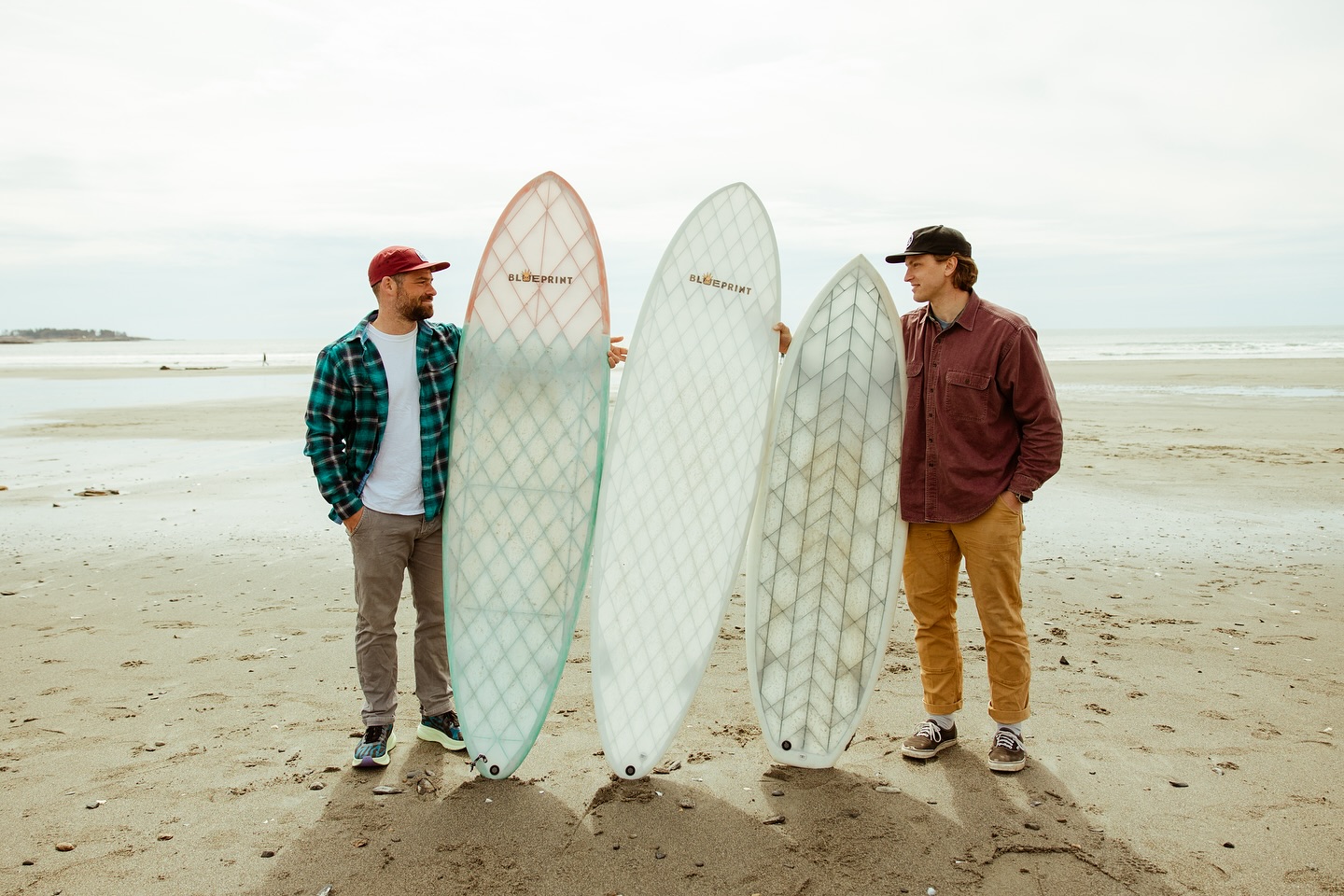
Life in Maine is shaped by the sea. That connection drove Luke Diehl and Mike Ballin to build Blueprint Surf, a Portland-based company reimagining surfboards that balance performance with sustainability. Drawing on their combined backgrounds in engineering and 3D printing, they craft boards that are as uniquely beautiful as they are environmentally responsible. What began as an ambitious experiment has grown into a brand that turns recycled materials into high-performance, lightweight surfboards built for Maine waters and coastal communities.
Q&A as told to CEI by Blueprint Surf Co-Founder, Luke Diehl, in his own words, with minor editing for context.


Can you introduce yourself?
My name is Luke Diehl. I’m one of the founders of Blueprint Surf, along with my business partner, Mike Ballin. We started Blueprint Surf in 2021.
Can you share a bit about your background?
My background is in aerospace engineering, and I’ve worked in the medical device industry my whole career, up until co-founding Blueprint Surf. When we were discussing going into business together and starting Blueprint Surf. We were looking at – do we start this business in Boston, or do we start it in Maine? Mike really advocated for the community in Maine, access to the waterfront, and the attitude of “being able to do it yourself, get your hands dirty, and figure it out”. All of that has really been proven true over our time running the business.
Describe Blueprint Surf in one sentence.
Blueprint Surf is devoted to making beautiful surfboards that people can feel passionate about.
Why did you start Blueprint Surf?
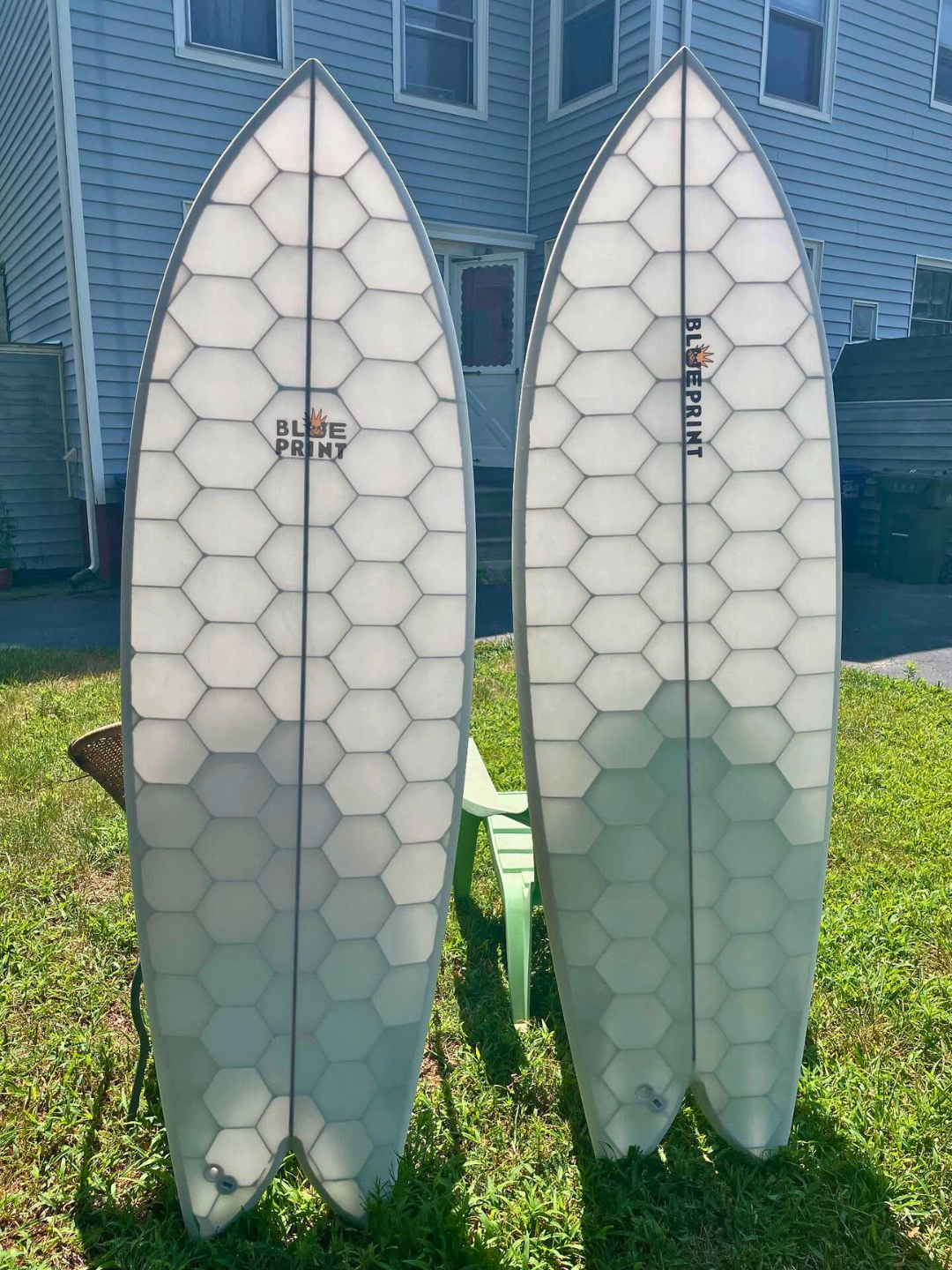
Mike and I were really excited about this. We went surfing together and started talking about it when we were in the water. We met up a couple of times, then we ordered some parts that were 3D-printed. We tried to build them into a surfboard, but it didn’t really work that well. But in discussing it and trying to solve all these problems, we got addicted to the challenge. Then, we started seeing some really cool potential for 3D-printed surfboards to be able to do things that other surfboards can’t. We’re still developing that technology, but we come across this unique aesthetic and a cool feel that the boards have when you surf on them. That just keeps us hooked.
What has been the greatest challenge so far?
Our greatest challenge to overcome has been managing and operating the 3D printer. To make our 3D printer work consistently, we’ve had to modify it a lot, really understand how it works, and rebuild it a couple of times to make it better. The biggest single challenge that we faced was that as soon as we felt like we got the 3D printing dialed in, the supplier of our recycled plastic went out of business. We had to go back to square one and basically redo the entire setup for a new source of recycled plastic and a new type of plastic overall. It cost us six months, making it a challenging time to stay focused and motivated, because what we really like doing is building the boards, not tinkering with a 3D printer.
How did you overcome those challenges?
We solve these challenges by basically devoting ourselves to them and learning everything we need to learn to overcome them. We knew we couldn’t keep making boards until we found a new materials supplier. That’s one of the nice things about being in a startup. You don’t have too many different things to work on; it’s just “hey, if there’s a big problem, then you have to solve it” before you can get back to doing the rest of the business. It was just a tremendous amount of effort, mostly on Mike’s part, because he’s the real expert at the 3D printing hardware. It was extremely impressive that he was able to buckle down and figure that out.
How do you see your work impacting your local Maine community?
It’s a difficult question while we’re small. The bigger we get, the greater impact we’ll be able to have. For now, promoting our values of environmental conservation and plastic recycling. I think that’s some of the biggest impact that we can have. It is “hey, this is what our brand is about”, sharing our values and hope other people see what we’re doing, and emulate the waste reduction we’re trying to create and values that we’re pushing.
How important is sourcing materials locally for your mission?
Everything we use is sourced domestically, and as much as we can we source locally. Maine doesn’t have a huge plastics recycling industry, but what it does have, we try to work with. It reduces our carbon footprint. It’s just the right way to do things, but even more, that’s just the way Maine works. If you can get something from the person down the street, then don’t order it from China or don’t order it from across the country; get it from the person down the street. We do that whenever we can; it’s faster, it’s cheaper, and most importantly, you get to know your neighbors.
What does “reduce your carbon footprint” mean for Blueprint Surf?
It means working with recycled materials, recycled plastics, 100% recycled whenever possible, which is almost everything that we do. We also used bio-based resin, which has a dramatically lower carbon footprint than Polyurethane or non-bio-based epoxy resin. 3D printing, sort of by nature, is a pretty low-waste process. It’s additive, so we’re not shaving stuff down, and shavings don’t go anywhere; we’re building up what we need.
In general, we do everything that we can, just because that’s sort of who we are. We don’t really expect that to be a driving factor behind whether someone buys our boards or not. It makes it so we feel good about running this business and making these products. What’s important for us is that our brand and our business are authentic to who we are, and if that’s important to us, then it should be a part of the brand.
How did you first learn about CEI?
The first person who pushed us over and recommended we go talk to CEI was either one of our mentors at The Roux Institute or Chris from the New England Ocean Cluster. The message was basically, “CEI is just a huge contributor to Maine’s entrepreneurial blue economy and coastal economy. They are someone that you guys need to be in touch with.” I was extremely surprised when I sent a cold email or made a cold call to someone at CEI and got a response within 24 hours. It was really exciting.
What made you decide to work with CEI?
We were looking for strategic business advice. Eventually, we hope that CEI will be able to make an investment in us or work with us in some financial capacity. But until we’re ready for that, our priority is to get the strategy and refine the business enough that we can grow, be stable, and run professionally.
We met one of the advisors at CEI, and I’ll be honest, I’ve started a number of successful businesses, so I wasn’t sure that we would benefit from working with an advisor. But the person that we talked to was extremely helpful, got to know our business really quickly, within the first meeting or two, was providing these great recommendations, and concrete, helpful business intelligence that we wouldn’t have had otherwise, so we definitely benefited from it.
What advice would you give to aspiring business owners?
Talk to everybody. Keep in touch with everybody you can. Because you never know when you need to talk to somebody about what it’s like to sail a boat, or whatever topic it is. We’ve been really surprised by how many times we’ve gone back to talking to someone that we had talked to a year or two earlier, and it’s been about a totally different subject than when we approached them for the first time. The community in Maine has been so helpful, open, and friendly. That’s an entrepreneur’s greatest strength; if the community’s willing, then let’s ask everyone for help. That’s what we’ve experienced, what we’ve learned, and what I would recommend for other entrepreneurs.
What excites you most about the future of your business?
We have some cool new technologies we’re trying to figure out how to launch. Once we can get them to market and prove that they’re what people want, then we can really start making larger contributions to the community.
For example, we negotiated an exclusive license for a really cool new recycling technology from Montreal. Basically, they’re making the world’s first 100% recycled content Styrofoam, or expanded polystyrene foam. There’s a problem in Maine right now where there is a ban on consumer Styrofoam goods, like food service wear, which means there’s no recycling infrastructure for Styrofoam in the whole state of Maine. But by necessity, Maine’s seafood industry uses Styrofoam fish coolers, because that’s the best way to transport fish and seafood. So, we have this issue where there is a large waste stream, but, for fundamental reasons, the state doesn’t have any recycling infrastructure to handle it. Now that we have this partnership, we want to dedicate the next year and a half of our work to figuring out how to turn Maine’s seafood industry’s Styrofoam waste into surfboards that are 100% recycled content, made in Maine, and built in Maine. It will be great for the community and great for the local marine ecosystem, because a lot of that Styrofoam gets broken down and ends up in the Gulf. For us to come out with a new product that’s 100% recycled content is just a massive upgrade on what everybody else in the industry is doing. It’s reflective of Maine’s values, reflective of Mike and I’s values, and our passion.
Anything else you want to share about Blueprint Surf?
We’ve had the opportunity to make these incredible products and these boards that we’re super passionate about. Whenever somebody purchases one, it makes us happy deep inside. A big thank you to all of our customers and to all of the Mainers who have helped us out along the way.
From the start, Luke and Mike used their passion for unique challenges to rethink how 3D technology and sustainability could coexist with a sport so deeply connected to Maine’s coastline. Their bold visions and relentless determination stood out to their business advisor, Raynor Large, Director of Business Advising at CEI, who shared:

It’s rare for an entrepreneur to have such vision, in the sustainable and renewable conversion of ocean waste into using the same ocean for pleasure and joy, while also fundamentally understanding the scientific and economic principles of growing a business. As an advisor, it’s all I could do to offer a little bit of help – and then get out of the way and cheer from the sideline!
With CEI’s guidance and business advising, Luke and Mike turned recycled materials into high-performance surfboards and a brand that reflects Maine’s sustainability, craftsmanship, and community culture. As they look ahead, Blueprint Surf’s next big goal is transforming Styrofoam coolers from Maine’s seafood industry into surfboards—proving that their big ideas can make waves for Maine’s future.